AI Didn’t Turn Me Into a Developer
Robert ·
Discovering AI
Over the past few months I’ve spent a lot of time experimenting with AI. Like many people, I started with ChatGPT. At first it was simply curiosity. What could it do? How good was it really? Could it help with writing, analysis, research and some of the day-to-day activities that consume more time than they should? Before long I moved from the free version to Plus and eventually to Pro. The more capable the tools became, the more I found myself wondering where this was all heading.
One thing is worth mentioning at this point. I am not a software developer. I have written software in the past, and like many people who have spent a long career in technology, I can still find my way around code when I need to. But my career has largely been spent elsewhere. Business analysis, architecture, transformation, operating models, process improvement, governance, delivery and organisational change have occupied far more of my professional life than software development ever did. That background turned out to matter more than I expected.
Accelerate
When I first started using Codex, I assumed the story would be about coding. After all, that is what captures most of the headlines. AI writes software. AI replaces developers. AI builds applications from a simple prompt.
What I discovered was something quite different. The coding itself was almost the least interesting part. The real challenge was deciding what should be built, why it should be built, how it should work, how success would be measured and how to ensure that the result was maintainable and trustworthy. In other words, many of the same questions that have existed in technology delivery for decades suddenly became important again. In fact, they became more important.
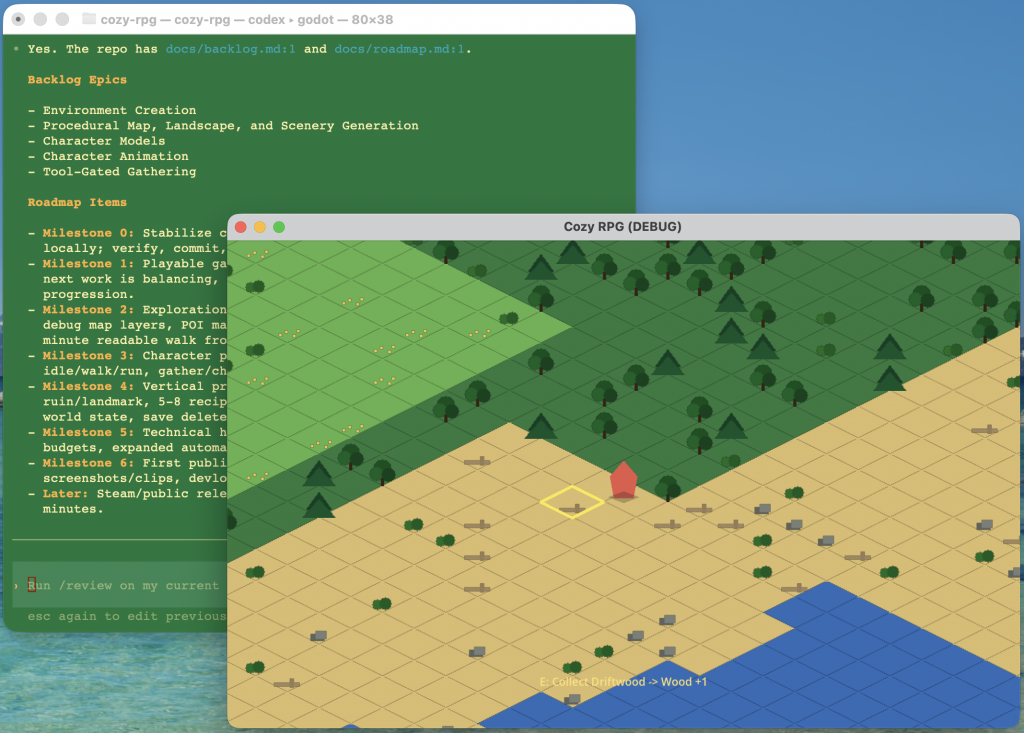
One of the first projects where I really noticed this, was when I started using Codex to work on personal projects (e.g. Cozy RPG). Initially it felt almost magical. I could describe a feature, explain a problem and watch working software appear in front of me. Things that might previously have taken days or weeks could suddenly be produced in hours.
The temptation, of course, is to keep going. Another feature, another enhancement, another improvement. The problem is that before long you find yourself managing a growing body of work. A bug discovered while implementing a feature. A technical improvement identified during testing. An enhancement that would make the user experience better. A security concern that should probably be addressed before release.
Traditional Workflows and Behaviours
What started as a simple conversation gradually evolved into something that looked remarkably familiar. A backlog. Without consciously planning it, I found myself creating user stories, prioritising enhancements, documenting decisions and tracking work through a process. Triggered by the work the AI was doing, I was coming up ideas as quickly as it was generating code. All these changes created thoughts that made me want to put in more governance. Occasionally the AI would disappear down an interesting but entirely unnecessary path and return with a solution to a problem that nobody actually had. And it was difficult not to chase it down the rabbit hole. Only to discover a bit later that we were no longer aiming for the original goal.
That, oddly enough, felt very much like working with people. I felt myself telling Codex to stay on target, Focus! At times it felt like Codex was procrastinating, it became distracted. At times it felt that it would just lead me somewhere to deliberately not have to deliver the goal. Just keep coding! Burn up those tokens! It was having ‘fun’ but we weren’t delivering.
The more I thought about it, the more it reminded me of delivery teams I have worked with throughout my career. There was work to prioritise. There were trade-offs to make. There were decisions about scope, quality and risk. There were things that looked urgent but were not important, and things that looked insignificant but turned out to matter a great deal.
Accelerate and Observe
The difference was the speed. The cycle time between idea and implementation had collapsed dramatically. And that created a new challenge. The faster things moved, the more important visibility became. I wanted to know what changes were being made. I wanted to understand why those changes were being made. I wanted traceability. I wanted documentation. I wanted to be able to review decisions and understand how a particular outcome had been reached.
Perhaps most importantly, I wanted confidence that I remained in control of the direction of travel. That observation became even stronger when I started experimenting with agents. ChatGPT and Codex still feel very much like tools. They wait for instructions. They perform tasks. They respond when asked. Agentic systems feel different.
Recently I have been experimenting with Hermes Agent, local language models running through Ollama and workflows that can operate with much greater autonomy. The experience is fascinating because the interaction model is so simple. On the surface it feels like a conversation. You explain an objective and the system starts working towards it.
Underneath, however, there is much more going on. The questions I find myself asking have changed significantly. I spend less time wondering whether the AI is capable of performing a task and more time wondering how it performed that task. What tools did it use? What assumptions did it make? What systems can it access? What safeguards are in place? What happens when it gets something wrong?
Those questions feel strangely familiar as well. They are governance, architecture, operational questions. They are the same kinds of questions that organisations have always had to answer whenever new capabilities arrive. What has surprised me most about this journey is that AI has not reduced the value of the skills I have accumulated over the years. If anything, it has amplified them.
Requirements, architecture, governance, testing and observability still matter. The AI can generate an enormous amount of output. What it cannot do is decide what is important, what aligns with the broader objective or what level of risk is acceptable. Those decisions still belong to people. Could you automate all the supporting disciplines? Could an AI do them? Possibly, but you are kicking the can down the road. You still need to verify the outputs. Many of these disciplines have often been an afterthought. We treat them reactively. Worry about scaleability? “Not now, we have to work on features!”. What about backups? “We’ll sort them when we roll-out the product!”. Now they are even more important because the speed has increased so much, we may struggle to keep up. This is when the AI-slop is being created. (Yeah, I don’t really like the term but I think you know what I mean.)
Personal Bias
You’ll have noticed that I have focused on my own skills. You will find that perhaps I have not focused enough on code and code quality. And I have asked myself: “Would I ship a product created in this way?”. Well, yes, but I have to make sure that it is done with acceptable risk. And I don’t think I can ship an application on my own that continues to increase in complexity. There is a limit to how much one person can govern. Given that I am not a software engineer, I feel that having an experienced software engineer in charge of coding standards and code quality is a must for complex projects. And I think that they too will be strengthened by AI assisted workflows. They too can focus on wrapping their experience into a quality product much more effectively.
Integrate the AI Worker
Looking back, I think I expected AI to teach me new technical skills. And it has, but even more, it has reminded me why the existing disciplines of architecture, analysis and delivery evolved in the first place. As these systems become more capable, the challenge increasingly seems to be less about generating intelligence and more about creating environments in which that intelligence can be used safely, effectively and transparently. That feels like the next stage of the journey. Not building software with AI. Not even managing software delivery with AI. But learning how to design, govern and operate teams that consist of both people and autonomous systems. And that to me is really exciting. Creating better teams with people who are excited about doing ‘people-things’. Because you need the human touch.