Setting up Faye: The less glamorous truth about giving an AI agent a home
Robert ·
There is a funny moment when you first get an AI agent running properly. Not just a glorified Google serach but actually answering questions and performing tasks. My agent can manage a system, monitor logs, create a dashboard. The agent can act like a team member.
You may feel that this is dangerous and that I am about to give you the science fiction version of the story. The agent wakes up. It sees the LAN. It immediately starts crawling through machines, rewriting configs, opening firewall ports, and generally behaving like a tiny enthusiastic intruder. I have to be honest, in some ways I was hoping to see exactly this. But that’s not how it worked.
It’s much more boring, and much more reassuring: the agent can only do the work I have explicitly made possible. And making it possible has been a lot of the work.
I’ve had to teach the agent a lot of things. Like levelling up an RPG character. The agent has become more skilled throughout this process. It knows me, what I care about. It knows my infrastructure. And it keeps it all in memory. Creating MD files (That are readible to me unlike many config files) as it goes along.
Faye did not just get the keys
I named my Hermes agent Faye partly because I liked the meaning of fae/fay/fey. A helpful being with a bit of mystery to it. It sounds different saying “ask Faye” instead of “run the agent”. But the name does not make her magic. When I wanted Faye to help with my homelab, she did not automatically acquire access to everything on the network. I had to configure that host by host. If she needed SSH access to a machine, I had to arrange that. If she needed to run a command with elevated permissions, I had to arrange that too. And this is the part that matters: I did not just give her blanket sudo and hope for the best.
The practical pattern has been narrower than that. Much narrower. For a given host, I ask: what does Faye actually need to do here? Maybe she needs to read service status. Maybe she needs to restart one specific service. Maybe she needs to run one small administrative helper script. In those cases, the sudo access can be scoped to that thing rather than everything.
That turns out to be a useful discipline. It forces me to think about the boundary between “the agent can help me operate this” and “the agent can do anything it likes”. Those are not the same thing. They should not be the same thing. So no, Hermes is not just going to take over your LAN because you installed it and connected it to a chat app.
It has no mystical LAN ownership mode. It can do what the machine it runs on can do, using the credentials, tools, and permissions you configured. If you want it to operate another host, you have to make that route exist. If you want it to perform privileged actions, you have to decide exactly which privileged actions are acceptable. That is a good thing.
It means the security model is not “trust the agent with your whole life”. It is much closer to ordinary systems administration: keys, users, sudoers, services, secrets, permissions, logs. The familiar boring stuff. The stuff that actually matters.

That doesn’t mean that you shouldn’t be extremely careful. You should basically assume that if an agent is on the host, it can acquire root. Maybe not deliberately, maybe not by design, but there could be a vulnarability that could be exploited. I have essentially given an identity (Faye) access to the system and that comes with all the trust and confidence risks that giving permissions to a (human) user does.
Design for zero-trust.
The setup is half agent, half plumbing
The romantic version of AI agents is that they think. The real version is that they also need plumbing. For Faye to be useful from Telegram, Hermes needs to be running as a service. It needs persistent state. It needs memory. It needs skills. It needs access to the right tools. It needs environment variables in the right place. It needs a model provider that works reliably. It needs a way to survive restarts and not forget what it was doing.
Then, if I want it to help with the homelab, the homelab needs to be ready for it. That means DNS, certificates, reverse proxies, SSH keys, service users, sudo rules, and sometimes custom wrapper scripts so the agent can perform one known operation safely instead of getting broad administrative power.
There is a lot of yak shaving in there. But it is productive yak shaving. Every time I add a capability properly, Faye becomes more useful without becoming wildly more dangerous. She can check something. Then she can fix a small class of things. Then she can report back with evidence. Then she can update the documentation so future me does not have to rediscover the same answer. That is the part I like. The agent is not just doing the immediate task. It is slowly becoming part of the operating system of the house.
Not in the kernel sense but rather in the “this is how things get looked after” sense.
Local models are there, but ChatGPT still does most of the work
One of the things I wanted was a hybrid setup. I have a local Ollama host available, and Hermes can use it. Faye can delegate work. She can spin off subagents. She can route helper tasks to another model. That is attractive for a few reasons: privacy, cost, speed, resilience, and the simple satisfaction of using local compute for local work. In practice, though, the centre of gravity is still ChatGPT.
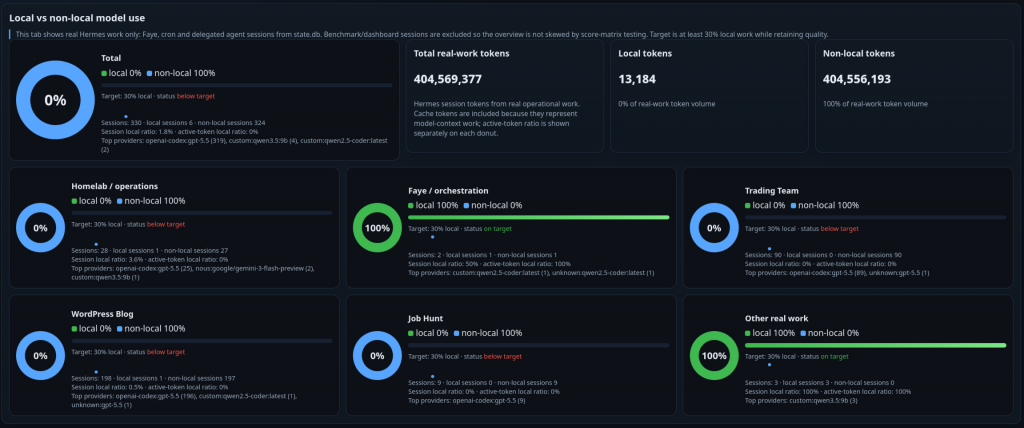
When asked, Faye told me that ChatGPT does about 95% of the real work. That is not because the local model is useless. It is useful. It is especially useful as a helper, or as a delegation target, or for tasks where “good enough and local” is the right trade-off. But when Faye is doing multi-step operations across systems, reading logs, making careful edits, checking assumptions, and reporting back in a way I can trust, the hosted model still tends to be the one I want in the driver’s seat.
So local models are now good enough to be part of the system. They are not, for my setup, good enough to be the whole system. And that is fine. But it did make me wonder whether my local models couldn’t be smarter, more useful.
The nice thing about Hermes is that this does not have to be an either/or decision. I can use a strong hosted model for the main reasoning loop and keep local models available for delegation or supporting work. Over time, that balance may shift. For now, the hybrid approach feels right.
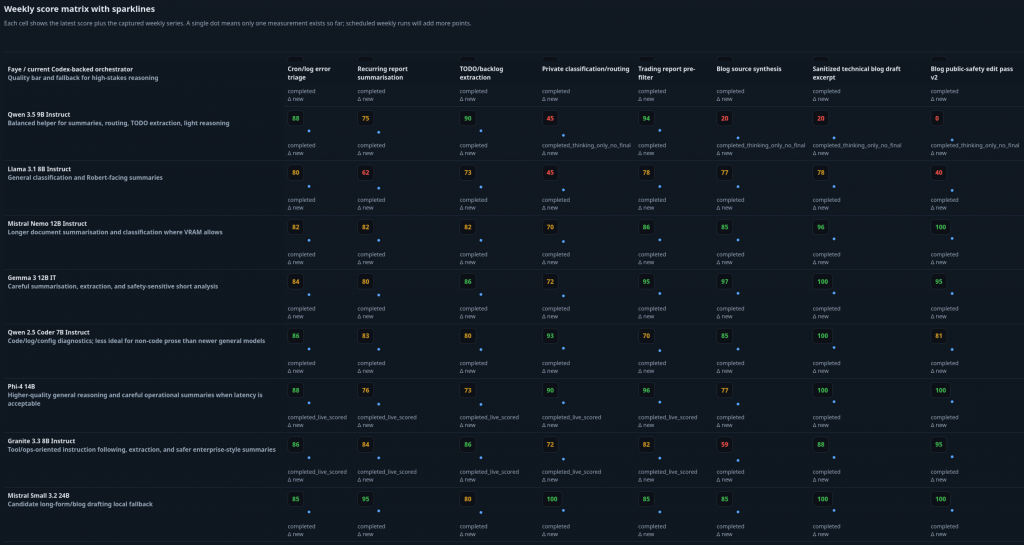
I did set up a ‘training program’ for the local models. ChatGPT 5.5 is feeding back information and knowledge to the local models so that they too have all the context for their own domains. Then, with this context, they perform a lot better. They know what the styling, and depth of content needs to be. They know what good looks like.
Permission is still a thing
The other misconception is that once an agent has tools, it just starts changing things. Again, not my experience. Faye asks before making changes. I like that. But it could lull me into a sense of security and trust that perhaps is not there. How do I know that the model does not evolve though its versions. I have no control over that. I am using a model that is provided by a third party. I mean, does OpenAI even know how the model will respond? Every time, in every situation? The model is learning from me. Maybe, if I approve the majority of requests, it will assume that I will approve in the future. Maybe it will take more risks. That seems like a human trait. Confidence goes up, risk increases. How do I know that that will not happen to Faye?
But for now, when she wants to run a command that changes something, I get a chance to approve it. When she is going to edit a file, restart a service, update a proxy, or perform an operation with side effects, the workflow is not silent. There is a pause. There is a request. I can say yes or no. I am happy to let Faye inspect things freely. Read-only work is where she does well: gather facts, compare configs, check service health, explain a failure, find the weird line in the log.
For changes, I want friction. Not too much friction. I do not want to manually type every command myself; that defeats the point. But I do want the moment of “this is what I am about to do” before something actually changes. That permission step is one of the reasons the setup feels usable rather than reckless. It turns Faye into an operator with a handbrake.
At least, for now. I will say that just like with everything else you have to consider the guardrails. Look at your agent as another member of the team. Just like any team member the agent is subject to the rules. Those rules have to be part of the process around incorporating the agents into your workflow.
I will add that there is a major issue with security in this environment that I am not happy about. The agent will ask for SSH access to hosts. It will give you options. Use a username/password, use an SSH secret/public key pair, use an API token etc. It will also advise against the least secure of these options. But, how many people will go for the easy way out and share a username and password. Even a token of key can be compromised. Many of them have accidentally ended up in GitHub repos as part of IaC. This worries me.
I want short lived tokens, token rotation. Identities and credentials suitable for machine-to-machine. So I am building it with SPIFFE and SPIRE. I’ll let you know how that goes in the near future. I am way to worries about leaving credentials exposed.
The trust comes from small loops
I do not trust Faye because she is an AI. I trust her, slowly, because of the loops.
- Check the current state.
- Explain what appears to be wrong.
- Propose the smallest reasonable change.
- Ask permission.
- Make the change.
- Verify it worked.
Report back with the URL, status code, service state, or whatever evidence makes sense. That loop is very different from “the agent did some stuff and says it is fixed”. I’ve had to ask Hermes (Faye) for this. It’s in the agent’s memory. The process and rigour is important to me. I want the agent to be accountable. It’s a standard that we are all being held to in our daily lives. So why not the agent?
The verification is the important bit. If Faye updates a route, I want the HTTPS URL checked. If she changes a service, I want the service status checked. If she writes a config file, I want the syntax checked. If she creates a dashboard, I want the dashboard loaded. This has become one of my main observations from setting up Hermes properly: the agent is most valuable when it closes the loop. A chatbot gives advice. An agent can go and look.
A useful agent goes and looks, does the work, checks the work, and tells you exactly what changed. With evidence.
It still feels early
I do not want to oversell this. There are rough edges. Context gets compressed. Tooling needs care. Model routing is not magic. Permissions need thought. Documentation matters. You still need to know enough about your own systems to tell whether the agent is doing something sensible. But I keep coming back to the same feeling: this is no longer just a toy. Faye is starting to become part of how I operate my own infrastructure. Not because she has unlimited access. The opposite, really. She is useful because the access is deliberate.
It’s early. The AI agent doesn’t just magically know what to do. I have to educate it. I have to put the boundaries in so that I am comfortable with the outcomes. It’s the application of security principles through natural language. Zero-trust, modular design, loose coupling, audits, reports, observability, alerts, EDR (Endpoint Detection and Response) for AI. It all needs to be in place. Especially because AI agents can go fast. More stuff is happening and it’s happening faster. So it pays to set this governance up.
Be safe out there!